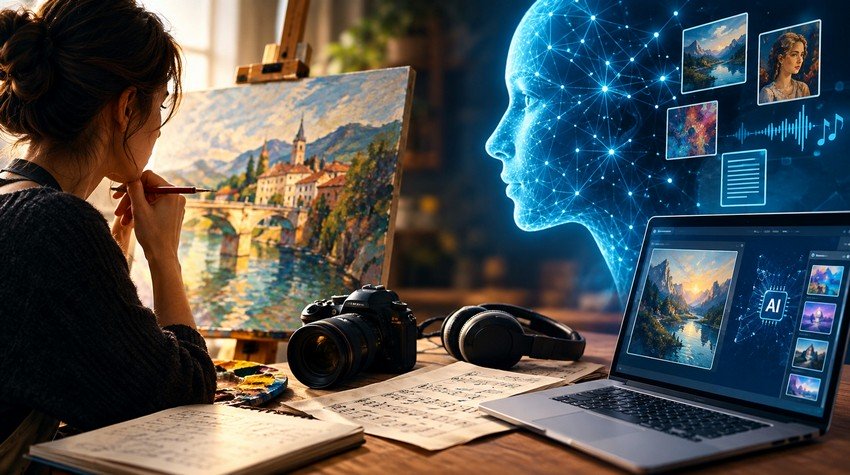
Artificial intelligence can now write texts, compose music, create photographs and develop designs in just a few seconds. As technology continues to push the boundaries of what is possible, the question of what makes human creativity unique in such a world is being raised more and more often, as is whether the value of artistic work can be reduced to its final result.
HEDONIST magazine looks back at one of the events that sparked a debate about the relationship between art and technology in 2018, when the portrait Edmond de Belamy, created with the help of an algorithm, was sold at a Christie’s auction in New York for $432,500.
This case demonstrated that a work created with the help of artificial intelligence can attract considerable attention and achieve a high price on the art market. At the same time, it raised questions about authorship, originality and the right to recognition for the work involved in creating such a piece.
Similar dilemmas have emerged in photography and music. AI-generated images have won awards, while digitally recreated voices of famous musicians have shown just how easy it is to produce content that audiences can mistake for the original.
Faster and More Accessible, but Is It More Original?
One of the greatest advantages of artificial intelligence is its ability to accelerate the creative process and make certain tools accessible to a much wider range of people.
However, content that appears convincing is not necessarily original. Research suggests that artificial intelligence can help individuals develop more creative ideas, but that the results produced by different creators using AI can also become more similar to one another.
This raises an important question: does technology encourage creativity or subtly steer us towards content that is already familiar, accepted and expected?
Technology Changes Art, but It Does Not Have to Eliminate It
The fear that new technology will threaten traditional forms of creative expression is nothing new. The emergence of photography once caused concern among painters, but it also created opportunities for new artistic movements and different ways of expressing ideas.
A similar transformation took place in the world of watchmaking, where more accurate and affordable quartz movements reshaped the market, while mechanical watches retained their value precisely because of the craftsmanship, tradition and time invested in making them.
These examples show that technological progress does not necessarily erase the value of human work. Sometimes, what machines are capable of replacing is precisely what people begin to appreciate more.
Human Experience as a Measure of Value
Although artificial intelligence can produce a text or melody that evokes emotions, the question remains whether a work of art is simply what we see and hear, or whether the story behind it matters as well.
Sevdalinka, for example, is more than just a combination of melody and lyrics. Its value often lies in experience, memory, loss and the emotions that the performer conveys to the audience.
This is where an opportunity emerges to reflect on the limits of technology. Human creativity is not based solely on technical skill, but also on personal experience, intention, risk and the willingness to express something that is not already known.
Who Is Behind the Work?
The development of artificial intelligence is also changing the way authorship and responsibility are understood. When a work is created with the help of an algorithm, questions arise about who its author is, who is entitled to recognition and who is responsible for its content.
That is why the debate about artificial intelligence is not only about what technology can do, but also about how society values human contribution.
Perhaps the most important question is not what humans can still do better than machines, but why it matters to us who is behind a particular work in the first place.
In a world where text, images and music can be created in just a few seconds, the distinctive value of human creativity may increasingly lie in authenticity, personal experience and the author's responsibility.
Because a result may be convincing, but the story of who created it and why may still be what gives it its special value.
 Privreda
 Energetika
 Turizam
 Poljoprivreda
 ICT
ICT Prehrana