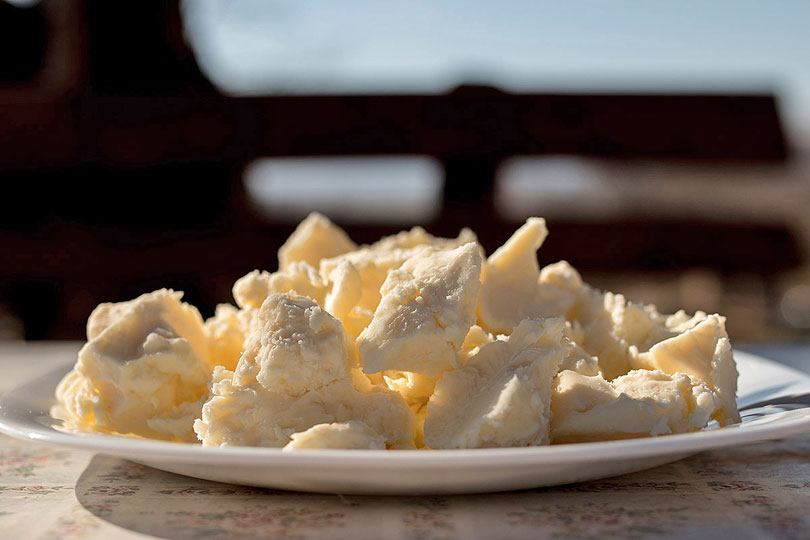
Traditional cheese ripened in a skin pouch, one of Herzegovina’s most distinctive local products, could soon receive significant international recognition. Preparations for its nomination to UNESCO’s Intangible Cultural Heritage List have progressed following the completion of documentation required to safeguard this valuable gastronomic and cultural tradition.
The initiative to preserve Herzegovina’s indigenous cheeses, with particular emphasis on cheese ripened in a skin pouch, was launched in Trebinje several years ago. The project involves the Slow Food Trebinje organisation and the Museum of Herzegovina, which have worked to promote and preserve traditional products and customs of eastern Herzegovina through the “Paths of Our Ancestors” project.
Božana Đuzelović, senior curator and ethnologist at the Museum of Herzegovina, explained that the initiative aims to protect a production method that has survived to this day with little change from the techniques used centuries ago. According to her, cheese ripened in a skin pouch was mentioned in the Dubrovnik Archives as early as 1337.
Following the launch of the initiative, the documentation was submitted to the Ministry of Culture of Republika Srpska and subsequently forwarded to the UNESCO Commission in Sarajevo. As a result, the cheese was included on Bosnia and Herzegovina’s preliminary list of intangible heritage, marking an important step towards its further protection.
A similar initiative has also been launched in the Federation of Bosnia and Herzegovina. The Faculty of Agriculture and Food Technology at the University of Mostar submitted documentation to the Federal Ministry of Culture and Sports for the inclusion of this traditional product on the Federation’s preliminary open list of intangible cultural heritage.
There is a possibility that the initiatives from both entities could be combined into a joint nomination, allowing cheese ripened in a skin pouch to be presented to UNESCO as a shared element of Herzegovina’s cultural heritage. Đuzelović believes that this would be a positive way to protect the tradition as a common cultural asset.
The uniqueness of this cheese lies partly in its traditional production process. After being prepared and partially dried, the cheese is placed in a specially treated sheep or lamb skin pouch, where it matures and develops its characteristic qualities. The recipe and production techniques have been passed down from generation to generation, and knowledge of its preparation is still preserved in many rural households across Herzegovina.
Local producers continue to uphold this tradition. Zdravka Ružić, who sells cheese and kajmak at the Trebinje market, including products made by her relatives in Berkovići, says that the cheese is prepared according to recipes passed down through generations of mothers and grandmothers. According to her, the traditional methods of curdling, drying and storing the cheese in a skin pouch have remained virtually unchanged.
Beyond preserving cultural heritage, official recognition could also bring tangible benefits to producers. International recognition would increase the product’s visibility, strengthen its market value and support local production. It could also help consumers more easily identify authentic Herzegovinian cheese.
For Herzegovina, cheese ripened in a skin pouch is more than a traditional food. It represents a part of the region’s identity, way of life and heritage, preserved over generations. Its potential inclusion on UNESCO’s list would recognise this legacy and provide additional encouragement to safeguard traditional practices for future generations.
(Source: Nezavisne novine)
 Privreda
 Energetika
 Turizam
 Poljoprivreda
 ICT
 Prehrana